01
Phonics & Spoken Expression
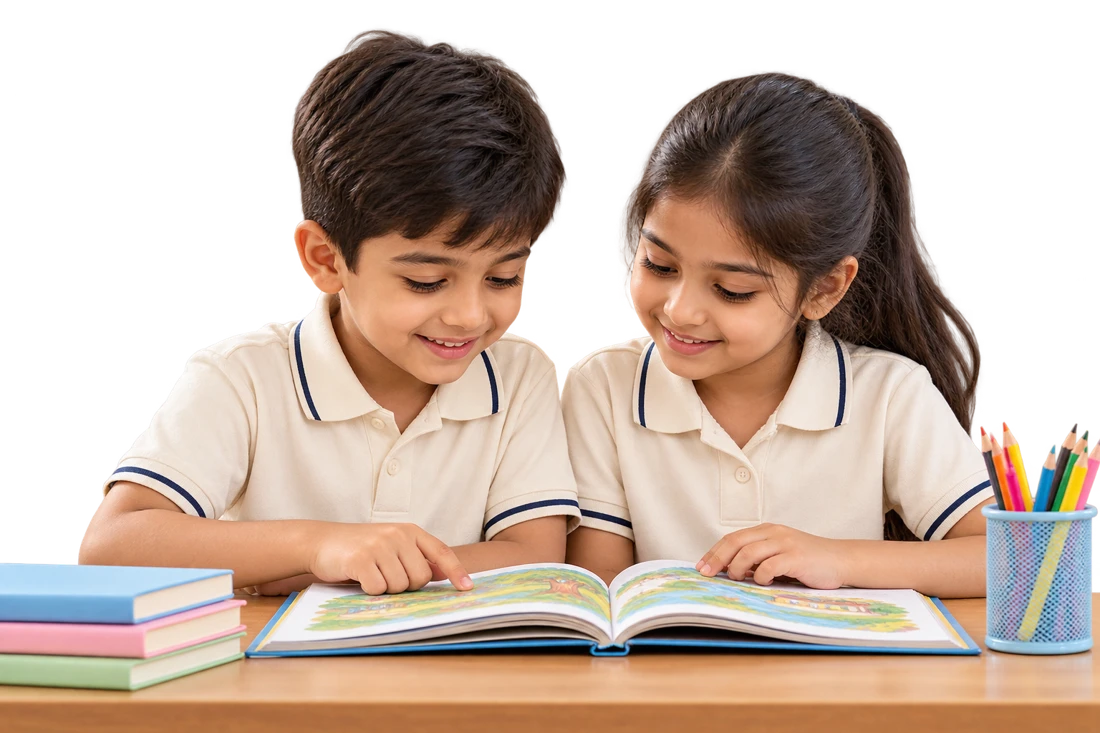
Interactive storytelling, rhymes, and phonemic awareness that help children articulate thoughts clearly and build early vocabulary.
Curriculum & Learning
At Rainbow Digi School, we nurture a lifelong love for learning. Explore our educational approach across the early childhood and primary years, from Nursery through Grade V.
Curriculum framework
A clear understanding of how our classroom learning is planned and delivered.
Rainbow Digi School delivers a curriculum aligned with CBSE learning standards, designed to build strong foundations in literacy, mathematics, environmental inquiry, and bilingual communication.
The school advertises a CBSE curriculum. For formal CBSE affiliation status, textbook selection, or class-specific syllabi, please speak with the school directly.
Stage 1: Early childhood
Early childhood education at Rainbow Digi School is designed around how young children naturally discover the world: through tactile exploration, storytelling, rhythmic songs, and guided social interaction. Rather than formal testing, educators nurture listening skills, phonetic awareness, and early motor coordination.
Interactive storytelling, rhymes, and phonemic awareness that help children articulate thoughts clearly and build early vocabulary.
Counting concrete objects, recognising shapes, identifying visual patterns, and understanding basic size and quantity relationships.
Clay shaping, paper tearing, crayon control, block building, and guided play that strengthen hand-eye coordination for early handwriting.
Sharing, listening in small groups, following gentle daily routines, and building emotional confidence around peers and teachers.
Stage 2: Primary education
As students transition into primary schooling, the academic framework broadens into structured subject learning under an advertised CBSE curriculum. The emphasis moves from guided discovery toward conceptual clarity, structured reading comprehension, mathematical calculation, and scientific inquiry into the surrounding world.
Reading fluency, grammar foundations, descriptive writing, and bilingual expression that encourage children to communicate with clarity and confidence.
Conceptual arithmetic (addition, subtraction, multiplication, division), word problems, geometric intuition, and foundation-level logical reasoning.
Exploring plants, animals, natural resources, community roles, and physical phenomena through observation, questions, and simple experiments.
Teacher-guided computer awareness, interactive classroom multimedia, and age-appropriate technology understanding with balanced screen exposure.
Classroom pedagogy
We replace rote memorisation with active discovery, guided exploration, and meaningful teacher-student discussions.
Concepts are introduced through concrete models, visual diagrams, and interactive activities before moving to abstract workbook exercises.
Teachers observe day-to-day understanding, project participation, and curiosity, reducing stress while providing timely developmental feedback.
Classroom dialogues encourage children to ask 'why' and 'how', cultivating independent inquiry and confidence in sharing ideas.
For thoughtful families
When you speak with our academic team, these practical questions can help you understand how our teaching aligns with your child’s needs.